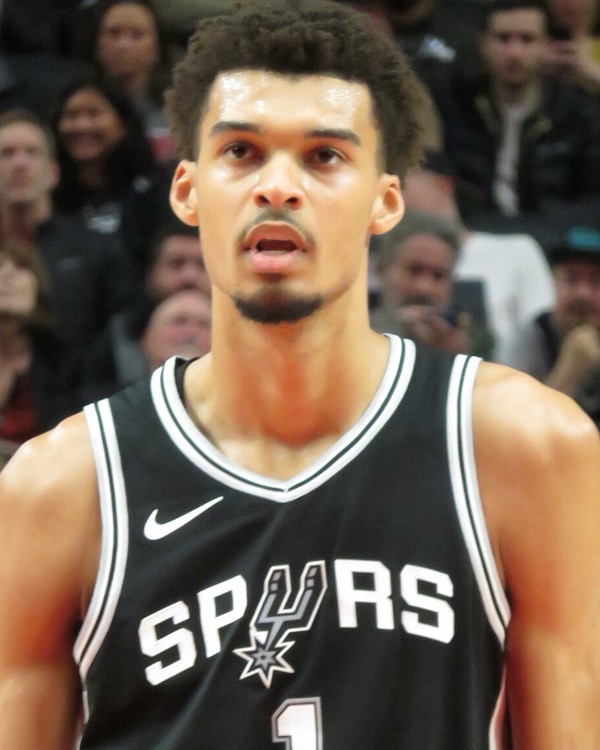
The box score says Victor Wembanyama averaged 25.0 points, 11.5 rebounds and 3.1 blocks in 2025-26. It’s spectacular, but it doesn’t tell you much about what changed. To see that, you have to look at how those points come, what he gives his teammates, and what the team becomes when he’s on the floor.
It’s the approach popularised by Ben Taylor and his Thinking Basketball channel: distrust averages, and look for the metrics that describe a role. We applied that lens to his three NBA seasons.
- 62.6%True Shooting in 2025-26, up from 56.5% as a rookie
- 41.7free throws drawn per 100 shots, almost double his 2024-25 rate
- 100thleague percentile in defensive impact, per CraftedNBA
TS%: shooting efficiency, counting free throws and threes.
FTr: free throws attempted per 100 shots. Measures how well he draws fouls.
3PAr: the share of his shots taken from beyond the arc.
Offensive Load (Ben Taylor): the share of possessions where he acts directly, by shooting, creating or turning it over.
Box Creation (Ben Taylor): estimated open shots created for teammates, per 100 possessions.
Portability (Ben Taylor): how well his game holds up next to other very good players.
Box Plus/Minus (Daniel Myers): impact estimated from box score stats, in points per 100 possessions.
CraftedNBA's impact metric, combining box score and tracking data. 2025-26: 100th percentile in the league.
A predictive metric (Kostya Medvedovsky): estimates a player's true level by weighing his whole history.
The real change: what he stopped doing
The most telling stat of his season isn’t a points total. It’s the share of his shots taken from three: 47% in 2024-25, 32% in 2025-26.
In his second season, Wembanyama had drifted far from the basket. It was spectacular and sometimes effective, but it also meant giving up his main advantage: being 7’4”. A bit like owning a ladder and taking the stairs. In 2025-26, he took fewer long shots, attacked more, and drew fouls. His free throws drawn per 100 shots went from 22 to almost 42.
The result: his True Shooting, which counts free throws and the extra value of threes, jumped from 59.4% to 62.6%. He didn’t score much more, he scored much better.
Creating for others: not yet
This is the limit of his season, and the numbers are honest about it. His offensive load, the share of possessions where he acts directly, went up (47.6). But his creation for teammates stayed flat, around 8 open shots created per 100 possessions. On passing alone, CraftedNBA rates him only league average.
Wembanyama has become an elite finisher and shot creator for himself. He isn’t a playmaker yet. That’s the next level, and it’s often what separates the very great players from the ones who win titles.
Defense: the same player, with better help
On defense, the consistency is striking. In his first two seasons, the Spurs gave up about 6 fewer points per 100 possessions with him on the floor.
| Season | Points allowed with him | Without him |
|---|---|---|
| 2023-24 | 117.2 | 123.1 |
| 2024-25 | 115.4 | 121.4 |
| 2025-26 | 110.0 | not published |
In 2025-26, the Spurs’ defense with him dropped to 110 points allowed per 100 possessions. We couldn’t find a reliable number without him, so we can’t measure the gap. But the other indicators say the same thing: over his last two seasons, 100th percentile in block rate and 94th percentile in rim protection per CraftedNBA, and the first unanimous Defensive Player of the Year award.
What the impact metrics say
This is where the analysis gets interesting, because the metrics don’t agree with each other.
The descriptive metrics explode. BPM, calculated from the box score, goes from 6.5 to 10.7. CraftedPM, which adds tracking data, goes from 6.2 to 8.7 and puts him at the top of the league.
The predictive metric barely moves. DARKO, which tries to estimate a player’s true level by taking his whole history into account, goes from 5.0 to 5.2. It is designed not to overreact to one season, especially one of just 64 games.
Both readings are right. The 2025-26 season was exceptional, and we know why: a smarter shot diet. The question is whether it’s a new level or a peak. The answer will depend on two things we’ll watch from October 20, when the Spurs host the Thunder on opening night: does he keep that shot diet, and does his creation for others finally improve.
The 2026-27 check-in
Updated November 14, after 13 games. First check-in on October 25, after 3 games.
After three games, we had one answer out of two. The shot diet was holding, the shooting wasn’t (47.6% True Shooting, dragged down by a 1-for-13 night against the Thunder). We wrote: “the method is there, the aim will come back.” It came back, and it brought friends.
Over his first thirteen games, Wembanyama is averaging 28.8 points, 11.7 rebounds and 4.2 blocks, with 62.8% True Shooting, a hair better than last season. The shot diet has been refined even further: fewer threes (28.7% of his shots), as many free throws, and much more work near the basket. According to NBA.com (as of November 13), he gets 10.2 paint touches a game (6.9 last season), scores 16.2 points there, and has 62 dunks, more than 24 entire teams. Along the way came the 52-point, 24-rebound night against Dallas, and those 40 points in 25 minutes in Phoenix.
| Metric | 2025-26 | 2026-27 (13 games) |
|---|---|---|
| Points per game | 25.0 | 28.8 |
| Blocks per game | 3.1 | 4.2 |
| Share of shots from three | 32.4% | 28.7% |
| Free throws drawn per 100 shots | 41.7 | 39.8 |
| True Shooting | 62.6% | 62.8% |
That leaves our second question, creation for others: 3.1 assists a game, the same as last year. He isn’t a playmaker yet. But at nearly 29 points a game for an 11-2 team, it’s hard to hold it against him.
The leap is real, and it’s mostly tactical: Wembanyama has learned how to use his size. He isn’t a playmaker yet. If he becomes one, no metric will be able to contain him.
The lab glossary
All of these are explained in more detail, with their limits, on our Method page.
- True Shooting (TS%): shooting efficiency, accounting for free throws and the value of a three. It’s the best simple measure of a scorer’s efficiency.
- Free throw rate (FTr): free throws attempted per 100 shots. A measure of how aggressively he attacks the rim.
- Offensive load, creation for others, portability: three metrics created by Ben Taylor (Thinking Basketball). The first measures how much the offense runs through a player, the second the open shots he creates for teammates, the third how well his game holds up next to other very good players.
- BPM (Box Plus/Minus): impact estimated from the box score, in points per 100 possessions compared with an average player. Created by Daniel Myers.
- CraftedPM: CraftedNBA’s impact metric, combining the box score with tracking data.
- DARKO: a predictive metric created by Kostya Medvedovsky. It estimates a player’s level at a given moment, weighing his whole history.
- On/off: the difference in points the team scores or allows, per 100 possessions, depending on whether he’s on the floor or on the bench. Telling, but sensitive to context: who plays with him, and against whom.
Sources
- Advanced metrics 2023-24 to 2025-26: CraftedNBA
- Spurs defense with and without him: Sports Illustrated, StatMuse
- 2025-26 basic stats: Land of Basketball · Defensive Player of the Year: CBS Sports
- 2026-27 check-in: ESPN box scores from October 20 to November 13, 2026, paint touches and dunks: NBA.com, Off-Ball calculations (True Shooting = points / (2 × (FGA + 0.44 × FTA)))
- 2026-27 schedule: Wikipedia