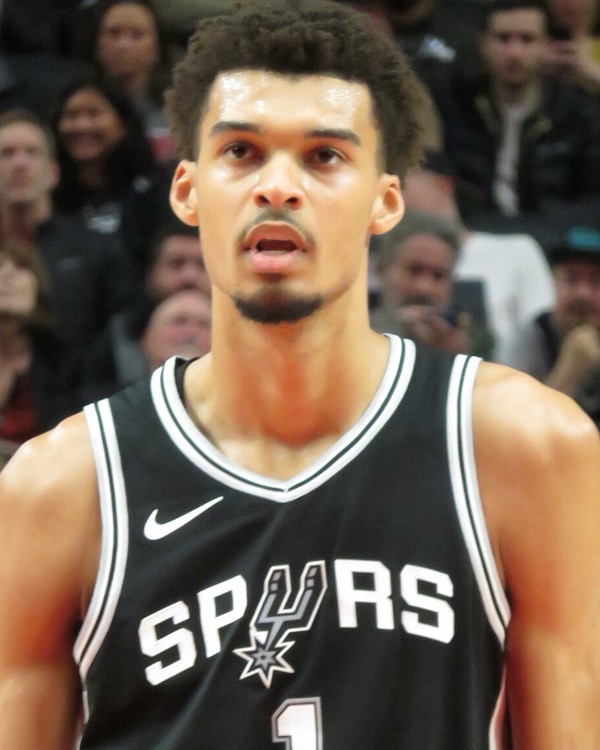
There are two ways to be an NBA star. The first is to talk about everything, all the time, on every platform. The second is to talk rarely, and make every word count. Victor Wembanyama has clearly chosen the second.
- 71posts on X since he opened his account
- 9.98Mviews for “Spurs family, I’m here to stay”
- 3rdin 2025-26 MVP voting, 4th in jersey sales
The player: a season that established him
On the court, the question is settled. Third in MVP voting behind Shai Gilgeous-Alexander and Nikola Jokić, with five first-place votes, he took the Spurs all the way to the Finals. They lost in five games to the Knicks. At media day in early October, he admitted to “a few sleepless nights”.
That’s the context for the July 10 tweet. A few weeks after the loss, nine words: “Spurs family, I’m here to stay. Whatever it takes.” No image, no video, no sponsor. The message was seen almost 10 million times, more than twelve times his follower count. We broke down how it spread in the thread.
The contract: $50 million left on the table
The tweet wasn’t just a declaration of love. The same day, July 10, Wembanyama signed a five-year, $252 million extension, the third-largest rookie-scale extension in history.
The detail matters more than the amount. He could have included the so-called “Rose” clause, which raises the salary from 25% to 30% of the cap if the player earns, in the coming season, an All-NBA selection, Defensive Player of the Year or MVP. At his level, he was very likely to trigger it: ESPN estimated the deal could have reached $303 million. He said no. According to Hoops Rumors, the Spurs will save about $50 million over five years as a result.
He explained himself to The Athletic a few days later: “The reality of the NBA today is that teams’ potential often isn’t reached because of money.” And what matters most, he added, is “our potential”.
It’s consistent with everything else. The player who rarely speaks chose to say one thing, first in words, then with his contract: he’s staying, and he’s paying so the team around him can grow. In the NBA, we’ve more often seen players ask for more than for less.
The spokesman: speak rarely, speak loudly
In early October, ESPN reporter Michael C. Wright reported that Wembanyama was turning down interviews with American media, with one exception: 60 Minutes. The information is second-hand, as Wright himself said it had been passed on to him. But it fits what we see: a nearly silent X account, few long interviews, and words that come when he decides.
And when they come, they can travel far. On October 8, at a press conference after the Spurs’ first preseason game, he was asked about the high-school protest movement in France. It started in schools in Paris’s northern suburbs, over teacher absences and run-down buildings, and spread across the country. The Interior Ministry counted 71,500 protesters that day, 24,500 of them in Paris.
His answer:
“These are systemic inequalities. I’m glad high-school students, and young people in general, are speaking up. I hear them, I support them.”
Then, more personally: he was in that situation “not so long ago”. He went to high school in Nanterre, where blockades already happened. If he made it out, he said, “it’s chance, it’s luck”. Earlier, on Instagram, a fan had asked him to join the protesters. He replied: “I’d love to.”
Why it matters
An NBA player commenting on the politics of a country other than the United States is rare. One who does it by pointing to his own school years, even rarer. Wembanyama doesn’t speak like an ambassador, he speaks like a former student.
There’s a risk, of course: being accused of stepping outside his role. But his strategy protects him. Because he speaks so rarely, nobody can accuse him of weighing in on everything. And because his results on the court are beyond dispute, it’s hard to tell him to stick to basketball.
Player or spokesman? It’s the wrong question. He’s one because he’s the other: his rarity gives weight to his words, and the weight of his words adds to his stature. It may be the most effective communication strategy in the league right now, and it fits in 71 posts.
Sources
- Support for the students: Al Jazeera, Sports Illustrated
- American media and 60 Minutes: Hoops Wire / Yardbarker, citing Michael C. Wright (ESPN)
- Extension: ESPN, Hoops Rumors, Hoops Rumors (interview with The Athletic)
- July 10, 2026 tweet: original post, counters as of November 14, 2026
- MVP voting: Basketball-Reference